Imagine a world.
Step into the possibility.
Prompt-created first-person environments, genuine action-conditioned AI video, and a separate hurricane rescue game where intelligent route planning matters.
Watch the real GPU evidence ↓This page shows real saved outputs. Live SDXL + Waypoint inference runs in our Windows application; no cloud GPU session or mock video is running here.
Historical 60-second fresh-seed recovery experiment. Browser canvas: 8.33 FPS.
RTX 4070 Ti SUPER. Persistent Waypoint FP8 inference; SDXL CPU offload.
Reported server drops, frame gaps and decode errors. Visual drift still remains.
Real generated video, honest comparisons
Choose a recorded recovery experiment. Videos contain genuine saved native720 frames at their sampled presentation timing. The video playback cadence is not the model's generated FPS.
Fresh prompt-consistent seeds · 28.73 generated FPS · 8.33 canvas FPS · three recovery cycles. Location changes and semantic drift remain possible.
Inspect actual benchmark records · Browser scheduling diagnosisFrom words to a starting world
SDXL HIGH generates recognizable first-person references at 1280×720 and 30 steps. These are real saved hurricane-themed SDXL images; they are not Waypoint video frames.


Creative prompts can describe neon city streets, underwater research bases, medieval courtyards, alien landscapes or Florida neighborhoods after a hurricane. The local app creates the image; Waypoint explores from it.
Open models do the meaningful work
SDXL → scene creation
The user prompt becomes an image through Hugging Face Diffusers, Hub downloads, Transformers, Accelerate and Safetensors.
SDXL model card ↗Waypoint → interactive video
Official World Engine conditions genuine native720 video on the starting image and keyboard/mouse inputs. Our service manages low-buffer streaming and lifecycle.
Waypoint model card ↗Rescue with purpose
Practice navigating hazards and rescuing survivors in a separate deterministic game. A* supplies a route comparison; AI Showdown presents existing PPO evaluations. The rescue map is authoritative for gameplay and does not share verified geometry with the generative video.
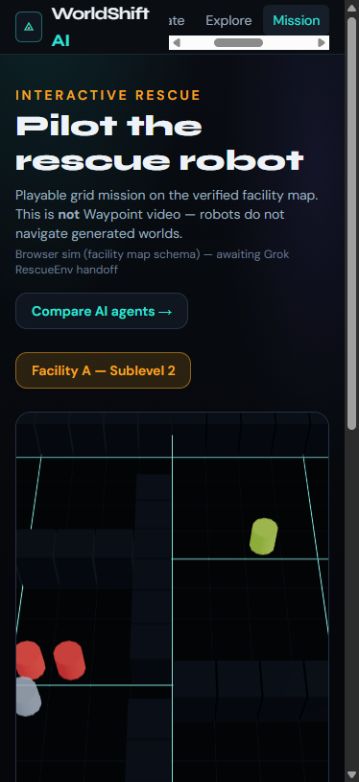 Recorded UI screenshot · deterministic rescue gameplay
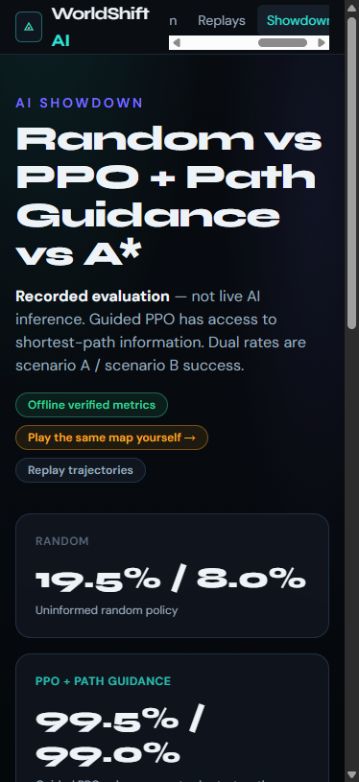 Recorded UI screenshot · existing agent evaluations
What works. What remains.
Working local components include prompt-to-image creation, real action-conditioned streaming, lifecycle controls and deterministic rescue gameplay. Long exploration can still smear architecture or lose theme fidelity. Clean references can recover a view but do not establish persistent geography. Enhancement may alter structure and block the shared GPU. Browser scheduling remains a presentation bottleneck; pointer lock may require drag-look fallback.
No persistent geometry, reliable collisions, exact camera headings, drift-free worlds or validated emergency-response training effectiveness are claimed.
Windows startup & saved-image fallback · Three-minute demo script · Submission narrative